

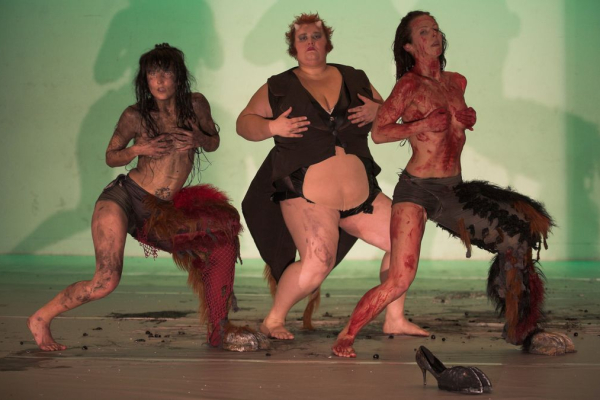
The satyr
“Transsexual deep diving á la Gergye, serving an ironic cavalcade of genitals, an amusingly uninhibited, wild and morbid revue squelching in fake blood – under Nietzsche's spell.”
(Ágnes Veronika Tóth, Revizor)
The first version of Krisztián Gergye's performance entitled The Satyr was shown in Trafó House of Contemporary Arts in 2005. “The author is reputed for almost never finishing, only stopping. As a diligent creative artist full of questions and doubts, he keeps correcting, modifying, redesigning and rethinking his works.” (exit) Viewers could first see the reinterpretation of the piece in September 2008 in Mu Theatre, while in December it will be played in the National Theatre.
“Krisztián Gergye is also a devoted Dionysus fan, that is, a freedom fighter determined to combat repression: no matter what it takes (…) he wants to reclaim the right of lost and denied pleasure. Still, by delicately mixing in his piece the forest demigods represented as part man and part animal of the Greek mythology called satyrs with Nietzsche's interpretation of Dionysus and with the exhibitionist figure grotesquely flashing his long coat representing the common meaning of the word „satyr”, the choreographer seems to keep some ironic distance. (…) Beautifully savage as the performance may be, it is still impossible to take it deadly seriously: it is exactly its extremeness and passion that contribute to its own parody, however, this is no accidental trespass, but a sure sign of artistic clairvoyance and a sense of humour.”
(Ágnes Veronika Tóth, Revizor)
“The Greek who had not been worked on as yet by any knowledge which kept culture imprisoned saw nature in his satyr, and so he did not yet mistake satyrs for apes. Quite the contrary: the satyr was the primordial image of man, the expression of his highest and strongest emotions, as an inspired reveler, enraptured by the approach of the god, as a sympathetic companion, in whom the suffering of the god was repeated, as a messenger bringing wisdom from the deepest heart of nature, as a perceptible image of the sexual omnipotence of nature, which the Greek was accustomed to observing with reverent astonishment. The satyr was something sublime and divine…”
(Nietzsche: The Birth of Tragedy…)
„Originally, the satyr was an imaginary creature of nature, the mixture of god and goat, emerging from the desire seeking for the original, natural state. (…) it is not the product of the Christian world, or not even the harmonious Greek culture, but is inherently rooted in savagery. Its barbarism means liveliness and vitality, the unconditional enjoyment of life tied to no guilt or ethics, which embodies in its strong sexual nature and emphasized corporeality. By using the figure (character) of the satyr it is possible to present the quality of body not yet oppressed by the soul in a cultural context.”
(Katalin Kimlei: Body Variations, Ellenfény, 2005/2.)