

Every year, MITEM in Hungary brings together international productions that combine classical and contemporary works, favouring experimentation with theatrical languages and unconventional perspectives on the present, subjecting today's world to analyses that are anything but comforting.
By Irina Wolf
Since its foundation in 2014, MITEM (Madách International Theatre Meeting) has served as a platform for dialogue between theatrical traditions and aesthetic approaches. The 13th edition of the festival took place from 20 April to 11 May at the National Theatre of Budapest. It opened with William Shakespeare's Richard III, directed by István Albu (Romania), and concluded with III. Ricárd, directed by Itay Tiran (Israel).
The framing concept—from one Richard to another—was not merely a curatorial choice but also a reflection on the current historical moment, with "a Europe on alert." Sophocles, Molière, Voltaire, Schiller and Gogol were all represented in the programme. Many productions explored the theme of power. At the same time, MITEM 2026 also featured performances in which the body and visual expression played a central role. With Pinocchio. What Is a Person?, directed by Davide Iodice, the festival posed not only the question, "Who holds power?" but also "How much is a human being truly worth?"
Marx's Contemporary Legacy
Among the twenty-six productions presented by twenty-one companies from fifteen countries, one of the most ambitious was Marxtőkéje (Marx's Capital).
In this National Theatre of Budapest production, director Attila Vidnyánszky invites audiences to reflect on Marx's ideas. The script, written together with dramaturge Réka Szabó, incorporates quotations from Marx's correspondence with Engels, speeches by Lenin and Stalin, as well as passages from the Bible. It also integrates elements from Agón, a drama by composer and philosopher Péter Pál Józsa.
The production portrays humanity's spiritual struggle, presenting human beings not only as the accused but also as the accusers, searching for meaning and salvation.
From the very beginning, the audience is actively involved. On the surface, the dramatic structure appears straightforward: spectators participate in a trial where the defence is represented by Marx, Engels, Lenin, Stalin and Mátyás Rákosi, Hungary's communist leader between 1948 and 1956.
Within a scenography dominated by red and black, evoking ancient Greek theatre, the defence lawyers stand before the audience, while the spectators themselves serve as the jury.
Although this premise is clearly established, the nearly four-hour performance gradually dismantles its own rules. The audience is introduced to Marx's private life. Brezhnev, Ceaușescu and other dictators born out of Marxist ideology appear as Russian nesting dolls. An orchestra—including a child drummer—is present on stage, while red ribbons are thrown into the auditorium.
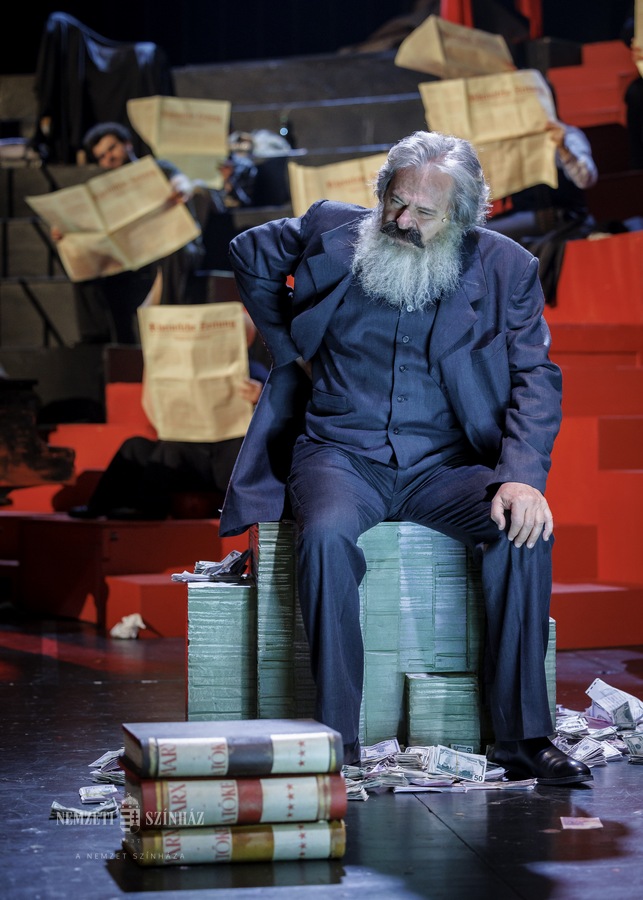
The production also references Marx's influence on more recent history, including the September 11 attacks and the phenomenon of fake news. One of the lawyers even wears a cap bearing the slogan "MAGA."
One lawyer wears a cap bearing the slogan "MAGA." Gradually, the narrative shifts increasingly toward religious symbolism, with frequent references to the Book of Revelation. The breaking of the Seven Seals is announced by a young woman dressed in white.
The conclusion drawn from Karl Marx's famous work is ultimately one of hatred, perpetual revolution, violence and destruction.
Toward the end of the performance, Adolf Hitler also appears on the stage. Saint John is defeated, hanging precariously from the ceiling while hell erupts below. Dressed in red suits with devil's tails, the five defendants sing and dance amid the sound of machine guns and projected images of tanks.
The enormous amount of text is made even more demanding by the director's overwhelming flood of visual imagery. The acting is impeccable, yet after a while, spectators unfamiliar with the historical and ideological references may easily lose the thread. Nevertheless, it remains an undeniably spectacular production.
Relationships Between Past and Present
Lelkem kukoricája (The Corn of My Soul) formed part of MITEM's programme dedicated to ethnic and linguistic minorities.
The production by the Galiasgar Kamal Tatar State Academic Theatre from Kazan, in the Republic of Tatarstan (Russia), takes its title from the expression Anton Chekhov used when writing about himself in letters to Lydia Mizinova ("Lika"), who would later become a singer, actress, translator and literary and theatre critic.
It is well known that the plot of The Seagull draws inspiration from episodes in Lika's life. They first met in 1889, when Chekhov was twenty-nine and she was nineteen.
Directed by Farid Bikchantaev, the performance is based on their correspondence, which has long fuelled speculation about the true nature of their relationship.
Fourteen young actors transform these exchanges of letters into an ironic and entertaining story about the fragile and ever-changing nature of happiness.
Originally created as a graduation production for the theatre academy, the performance was later incorporated into the theatre's permanent repertoire.
Fourteen chairs occupy the stage. Seven identically dressed men, each wearing a pince-nez, sit on one side, while seven women sit opposite them. Together, they represent Chekhov and Lika.
The production unfolds with lively rhythm, strong dramaturgical structure, and an imaginative theatrical language that remains immediately accessible to audiences.
As part of the Serbian–Hungarian Cultural Season, Akvárium (Aquarium) presents a psychological family drama.
Written by the young playwright Nina Plavanjac, who also directed the production for the Subotica National Theatre, the play follows three generations of women who pass destructive emotional patterns from mother to daughter after being abandoned by their husbands.
The youngest woman attempts to break this inherited cycle by moving abroad. Rather than marrying, she begins a relationship with a married man who is also her employer.
However, she is forced to return to her childhood home after her mother—who suffers from dementia—is expelled from a nursing home.
After years of silence, mother and daughter finally confront one another.
Past and present intertwine seamlessly in Plavanjac's staging.
The two women converse inside a transparent cube, while outside it wander the ghosts of the dead: the nursing home caregiver (who also embodies the grandmother), the husband who died because of alcoholism, and another deceased daughter.
At the emotional climax, two opposite walls of the cube slowly move inward, causing the mother to collapse.
The daughter remains alone inside the structure after her mother has crossed into the world of the dead.
As darkness gradually envelops the stage, images of fish swimming in every direction are projected onto the walls.
The family's destructive inheritance appears finally to have been broken, allowing harmony to be restored. *
(Translated from the Italian article, itself translated from the original English by Laura Bevione.)
(15 July 2026)