
MITEM13
A Russian Trace at MITEM: Chekhov in Tatar, Kolyada in Polish, Ryzhakov in Hungarian
Sometimes absence speaks louder than presence. At the 13th MITEM (Madách International Theatre Meeting) 2026 in Budapest, Russia does not take center stage and is not listed as a separate category in the program. Yet a closer look reveals, beneath the surface, an entire map of connections: the Russian theatre school, Chekhovian dramaturgy, directing biographies, and artistic routes leading from Moscow, Yekaterinburg, Kazan, and Almetyevsk.
This is neither a ceremonial return nor a cultural demonstration, but a far more interesting story. Here, Russian theatre exists not by virtue of official representation, but through its influence—through Nikolai Kolyada, Viktor Ryzhakov, the Galiaskar Kamal Tatar State Academic Theatre in Kazan, and the Almetyevsk Tatar State Drama Theatre.
MITEM—Madách International Theatre Meeting—was founded in 2014 by the National Theatre of Hungary under the leadership of Attila Vidnyánszky. From the outset, it was conceived as a meeting place for different theatrical schools, languages, and traditions. MITEM serves as a platform for dialogue, intended both to revitalize Hungarian theatre through encounters with other cultures and to introduce the Hungarian stage to international professionals.
In essence, Vidnyánszky has allowed theatre to remain wiser than politics—to preserve relationships built not on slogans but on artistic training, talent, and a shared language of the stage. Against the backdrop of increasing cultural isolation in Europe and ever stricter political filters, he has neither abandoned nor erased professional ties with the Russian theatre tradition. This is precisely why MITEM makes possible that complex, unofficial, yet vibrant map of Russian presence. There may be no flag, but there remains a sense of an uninterrupted conversation—professional, human, and artistic.
One of the most subtle examples is The Corn of My Soul by the Galiaskar Kamal Tatar State Academic Theatre. Formally, it belongs to the festival’s program of ethnic and linguistic minority theatres and is performed in Tatar with Hungarian and English surtitles. Yet at its core are Anton Chekhov and Lydia Mizinova—Lika, the woman from Chekhov’s circle whose name is most often associated with The Seagull.
Farid Bikchantaev’s production is based on Chekhov’s correspondence. Bikchantaev himself is a graduate of GITIS and a disciple of the directing school of Maria Knebel and Boris Golubovsky. What makes the Russian trace particularly fascinating here is that it does not pass through the Russian language. Chekhov speaks in Tatar and ceases to be a bronze classic from the school curriculum. He becomes the material of living theatre—something that can be appropriated, translated, and experienced through another culture.
The Kazan theatre does not illustrate Chekhov; rather, it returns him to the intimate realm of letters and nervous pauses. The title, The Corn of My Soul, sounds strange, almost awkward, yet within that awkwardness lies a deeply Chekhovian truth. In Chekhov, love is rarely expressed through beautiful formulas. More often it appears as a ridiculous, clumsy, wounding phrase that somehow survives those to whom it was addressed.
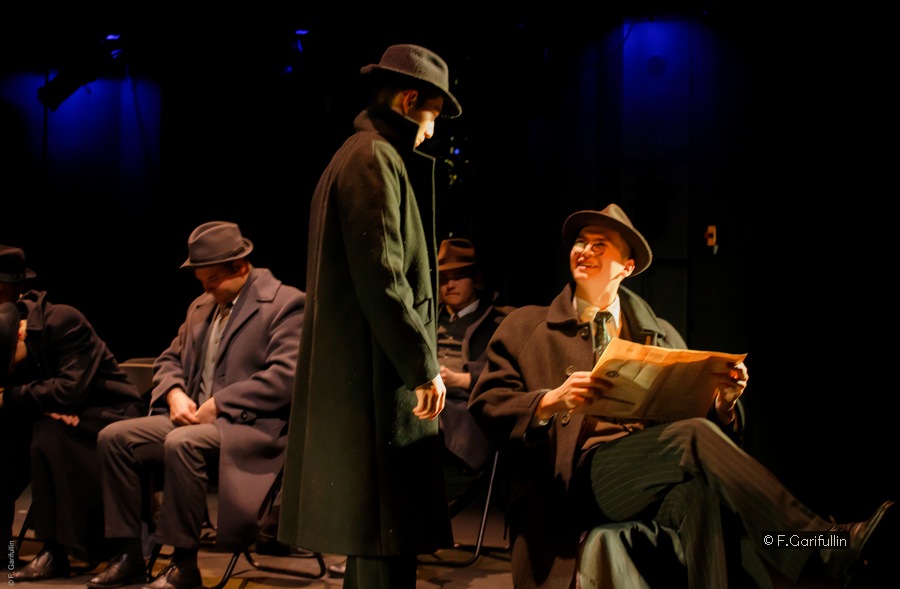
Another production is Queen of My Heart at the National Theatre of Budapest, directed by Viktor Ryzhakov. For Russian audiences, the play immediately evokes an important association: Nicola McAuliffe’s work is known in Russia through Konstantin Bogomolov’s production The Jeweller’s Anniversary at the Moscow Art Theatre. The late Oleg Tabakov chose the play for his 80th birthday celebration and entrusted it to Bogomolov. The production became one of the great actor’s final major roles.
The story is almost fairy-tale-like, yet relentlessly human. During preparations for the coronation of Queen Elizabeth II, a young soldier named Maurice guards the Crown Jewels at Buckingham Palace. He meets the future queen, falls in love, and receives a promise that they will meet again sixty years later.
Ryzhakov structures the production around love as humanity’s greatest expectation. His focus is not on the suspense of whether the queen will come, but on the cost of that belief for those around Maurice—especially Helena, his wife. In their relationship, love, jealousy, exhaustion, and self-sacrifice intertwine so completely that the romantic legend gradually transforms into a nearly cruel domestic reckoning.
The line, “I held your heart in my hands,” resonates not only as a declaration but also as a question: whose heart was truly sacrificed to this dream? The result is not a sentimental production, but a delicate and painful meditation on love as both the final illusion and the final justification for a life lived.
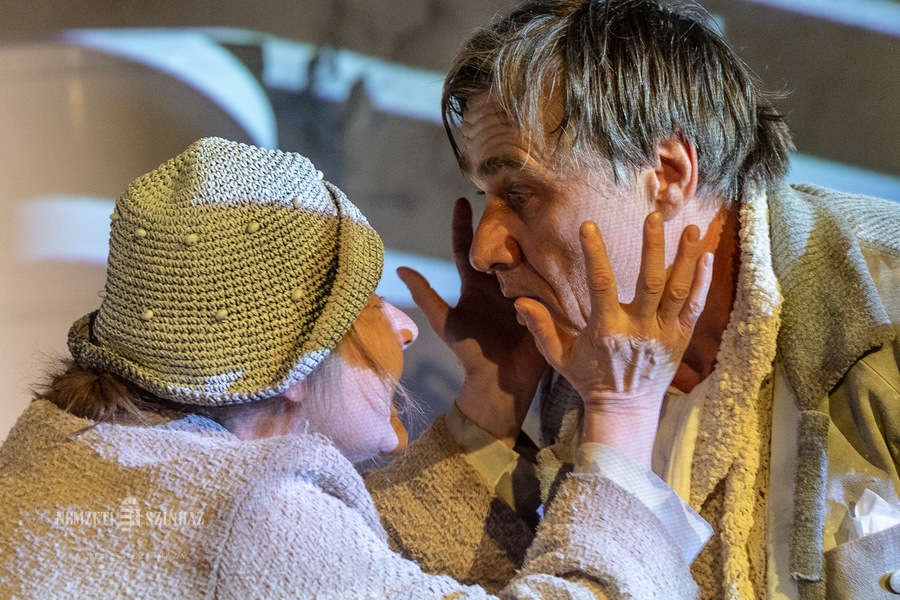
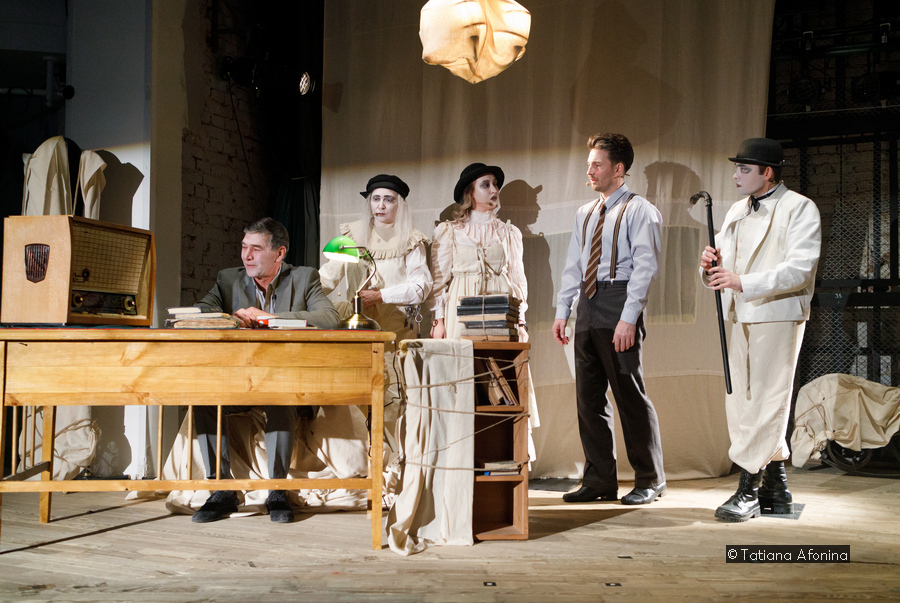
The Cherry Orchard by Nikolai Kolyada, who passed away this year, is the most direct and at the same time the most bittersweet Russian sign within the festival program. Chekhov, staged by a Russian director in Poland’s Witkacy Theatre, becomes a story about people afraid to make decisions, hiding from problems, and hoping that everything will somehow resolve itself.
Kolyada transforms Chekhov from nostalgia into a civilizational diagnosis. In his version, the cherry orchard is already gone; everything has been sold and destroyed. In place of white blossoms remain plastic cups—garbage that has outlived beauty. The new owner arrives not as the energy of the future but as the brute force of final devastation. He does not want the orchard; he wants holiday cottages, profit, and territory.
By the end of the production, as after a hurricane, everything has been swept away. From a world where people once lived, loved, and hesitated emerges not a human being but some lower, almost prehistoric form of life. Thus Chekhov’s comedy becomes, in Kolyada’s hands, a requiem for a world that perished not because of catastrophe but because of its own inertia.
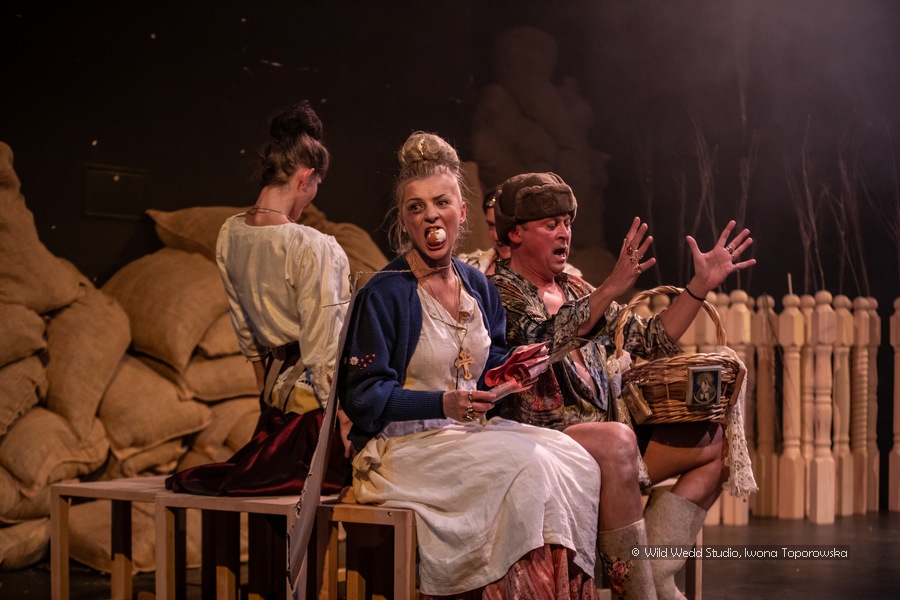
The fourth point on this map is Broken Melody by the Almetyevsk Tatar State Drama Theatre, directed by Sardar Tagirovsky. At its center is the life and fate of the Tatar composer Farid Yarullin, creator of the first Tatar ballet, Shurale.
This intimate production is about memory and the power of music to outlive its creator. It immerses the audience in pre-war Kazan, at a moment when a national musical culture was taking shape. Here, the Russian trace expands beyond the very word “Russian.” It becomes part of a broader cultural geography of Russia, where war, national music, Tatar theatre, and Soviet history coexist.
Almetyevsk is important because it prevents the discussion from being reduced to Moscow, St. Petersburg, Chekhov, and famous directors. MITEM presents Russia as a complex theatrical territory in which the Russian canon coexists with the Tatar language, and where “Russian” is not always synonymous with “Russian-speaking.”
In this sense, Broken Melody is not a regional footnote to the festival program but a reminder that Russia’s cultural map has always extended beyond its familiar metropolitan contours.
This is how a Russian trajectory emerged within the festival. It did not appear through a block of national representation, but through the very dramaturgy of the program: through Chekhov, who proves necessary to multiple theatrical cultures; through Ryzhakov, working in Budapest with a play that already carries memories of the Moscow stage; and through Almetyevsk, where Tatar music and the fate of Yarullin broaden the very notion of Russian presence.
There is no single center on this map and no familiar vertical hierarchy. Moscow stands alongside Kazan, Yekaterinburg alongside the Polish stage, the Tatar language alongside the Russian canon.
And thus the final meaning proves stronger than any political formula. Culture may be absent from a festival headline, but its influence cannot be erased. Russian theatre is already woven into the global language of the stage, and to pull out that thread would be to unravel the very fabric of the festival itself.
Once again, MITEM reminds us that theatre is sustained not by borders, but by intersections, connections, and continuities.
Emiliia Dementsova
(01 June 2026)